This Ipswich Chronicle column argues that the sale of Little Neck is not just bad for the schools, but also for the majority of cottage owners. How can this be? It has to be good for somebody, right?
There are three broad classes of people for whom this is a good deal:
1) Certain tenants, particularly those with the best lots on Little Neck. This is because the price at which tenants would buy their lots is not well connected to their value. We analyzed each individual lot on Little Neck to compare the amount the cottage owner would buy their lot for relative to its appraised value. At one end is the lot at 6 River Road, where the cottage owner would buy their lot at 40% of the appraised value. At the other end is 18 Bay Road, where the cottage owner would spend 107% of the appraised value. In doing this analysis we used the FinCom individual lot values (since it was the only one with that level of detail), but all four appraisals had variances in value that were significantly higher than the variance in the actual lot prices. The tenants own appraisal states at page 42 that there are “10 to 12 waterfront and or exceptional view lots at $400,000+” These same lots are priced just over $200,000.
2) The next category of beneficiary are the banks who will collect interest and fees on the value of the land at Little Neck for the next 350 years. While everyone talks about this as a sale of the land “to the cottage owners”, the reality is that most of the equity in the land at Little Neck will not end up with the cottage owners, but rather in the hands of lenders who will collect interest on the outstanding debt and charge fees for each refinancing. The cash that cottage owners use to service that debt is essentially all money that is being siphoned off from the Schools and exported out of our community. The cottage owners end up with a bigger cash drain, and the schools end up with less money. This is the lose-lose.
3) The last category of beneficiary, of course, are the Feoffees themselves who, if the sale goes through, will have received a release from liability from the tenants and the School Committee while having the school children pay all their legal bills.
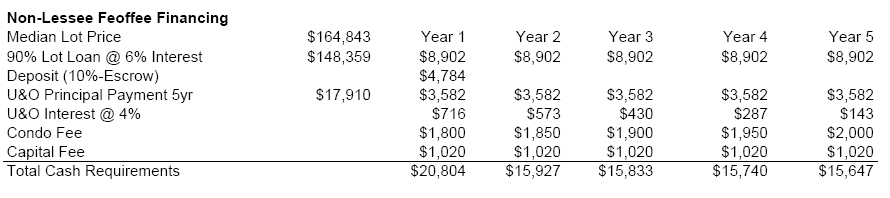
Is it really the case that cottage owners would have to come up with over $20,000 the first year and $15,000 the next four years after that? It seems impossible when part of the reason for the original lawsuit from the cottage owners was that the $9700 annual land rent was “too high”. Here is a cash flow chart for the median non-lessee cottage owner taking Feoffee financing (these images are more legible if you click on them):
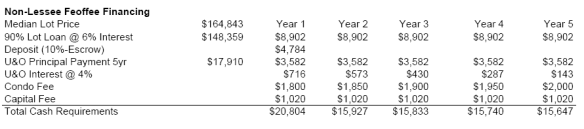 The median lot price (line 1) represents the price at which half the cottage owners are paying more an half are paying less. Feoffee financing is interest only at 6% (line 2) and requires 10% down, but most of that can come from the back rent escrow (line 3). The cottage owner’s share of the $2.4M in back rent can be financed as well, but the principal must be paid in full within 5 years (line 4). This debt is at 4% (line 5). Then there are estimated condo fees and capital assessments (lines 6 & 7). Note that this analysis does not include any allowance for the litigation legal fees which will be due at closing which for some cottage owners is apparently in the range of $5500.
For cottage owners that are fortunate enough to get conventional bank financing, things probably look a bit better, but still not as good as a reasonable lease. Here is a cash flow chart for the median non-lessee cottage owner taking conventional financing:
 Again, we start with the median lot value (line 1). We assume that the lender allows the back rent to be rolled into the principal of the loan (line 2). We also assume that the cottage owner has sufficient equity in the cottage itself that no further cash deposit is required at closing to purchase the condo unit. The debt service is calculated on a 4.25% 30 year note (line 3), which may be optimistic for second home financing in this market; any higher rate or shorter term will obviously increase the cash requirements. Condo fees and capital assessments are added as before (lines 4&5), and again there is no allowance for legal fees that might be owed.
Compare either one of these to a reasonable lease deal, which we define as something along the lines of what the cottage owners proposed back in 2008 that was rejected by the Feoffees. The annual cash requirements for a seasonal cottage owner in this proposal were under $9000, and we believe this could be made even less for most cottage owners by maintaining the gross rent total and simply scaling the individual lot rents based on the tenants own lot appraisals (similar to what was done with the back rent allocation).
It should be noted that this analysis is based on publicly available documents and is intended to describe the situation in broad terms for the median cottage owner. Hopefully it is obvious that we are not claiming to give anyone advice – cottage owners should retain their own independent legal counsel for that.
The bottom line is that in this lull when the courts are assembling the record for the appeal and we wait to hear whether the Supreme Judicial Court will hear it, there would be no harm in revisiting the concept of a below market rate lease. Public awareness and understanding of this issue has increased dramatically since 2008 and all parties might find it surprising how much common ground there might be if the animosity of the past can be put aside.


 Ipswich Citizens for Public Trust